Dutch Embasy
Berlin,Germany,2004
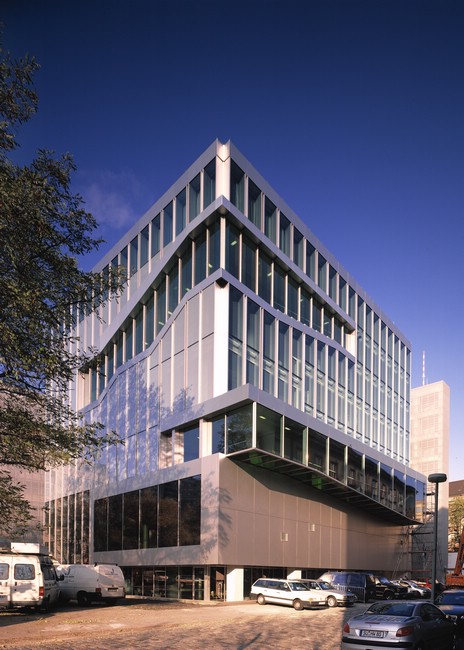
The new Dutch Embassy in Berlin is a classic Koolhaas building. It reveals traces of some of his best known works and concepts, such as the external metaphoric materialism of the Rotterdam Kunsthal and the internal structural and functional mazes of the Jussieu library in Paris. Yet compared with other current OMA mega-projects such as Seattle Library or the headquarters for Central Chinese Television, the Dutch Embassy is actually a relatively modest building.
坐落於柏林新型荷蘭大使館是一座典型的Koolhaas的建築物,該建築透露出些許他著名的作品和觀念,諸如在外觀上暗示鹿特丹Kunsthal和法國Jussieu大學圖書館內部結構功能性迷宮,但是比起其他目前OMA大計劃,西雅圖圖書館或中國中央電視總部,荷蘭大使館相對的是一座樸素的建築物。
Perhaps it was the choice of site in former East Berlin, now officially known as Mitte (literally ‘middle’), that incited such a highly controlled and introspective urban and architectural solution. Contrary to expectations, the central location does not exude the hustle and bustle of nearby Potsdamer Platz. Instead, Klosterstrasse (Monastery Street) runs quietly off the busy Stralauerstrasse and ends on the quayside of the river Spree where the water flows slowly and darkly into a lock. Few tourists find their way here unless on a river cruise. Development of the prominent corner site, which had been vacant since the war, had to conform to Berlin building regulations. These were precisely defined by the city’s former chief planner Hans Stimmann and any new building had to occupy all four corners of the site.
或許是選在前東德地段,現在官方叫做中間地帶,因而引發了高度控制和內向的都市建築方案。與預期相反,此中間地帶並沒有表現出鄰近波茲坦堡的擁擠和吵雜,反而是在克勞奚落修道院街(Klosterstrasse)很安靜地通過離繁忙史拉魯西來區,而且,結束於史普瑞河岸邊,此河水流緩慢暗暗地流入水閘。除非坐遊艇,很少觀光客會到這裡。開發自從戰後一直空著的主要地段,必須遵照柏林建築法規,由前任市規劃總裁Hans Stimmann精確地擬定,任何新建築要蓋在專區四角落範圍內。
Being well versed in overcoming the inhibitions of planning laws, Koolhaas managed to avoid a preconceived standard solution. Instead of proposing the customary atrium or inner courtyard, he created a free-standing monolithic 27 x 27m cube enclosed by slim L-shaped wings, so achieving a narrow but totally open courtyard while still fulfilling the requirement to build on all four corners. Call it Dutch irony, but the urban solution is both perplexing and intriguing.
頗為精通克服規劃案阻礙,Koolhaas經手避開預期的標準方案,不以慣常性的中庭和內院提案,他創造獨立聳立單一的27*27米立方體建築,包圍再細長L形側翼裡面,因此成形狹窄但仍然具有滿足四角落都要建造的需求之完全開放庭院。稱之為荷蘭嘲諷也罷,但此都市解決方案,同時具有複雜和奇特的特性。
In functional terms, the two spatially interlocked volumes are divided between offices located in the cube and apartments in the one-room deep L-shaped wings, along with plant rooms (the building is fully mechanically ventilated). Linked by five vertically stacked bridges, both volumes stand on a raised platform which serves as the underground car park for only 28 vehicles, despite staff numbers of 70. Underneath, a tarmac ramp leads up from the street level into the courtyard where the main entrance is located. From there a continuous 200m strip, or what Koolhaas calls a ‘trajectory’ (in effect, a succession of staircases, ramps and corridors), snakes its way up through the building. At some points it emerges on or even through the facade (in the case of the cantilevering glass corridor above Klosterstrasse), changing direction of ascent and gradient until it reaches the restaurant and roof terrace. Floors, ceilings and walls of this architect-styled ‘stairway to heaven’ are clad in aluminium and sometimes even in plain or coloured glass.
就功能來說,兩個空間連結的空間,被分割為在方格內的辦公室,和深長L形側翼的一個房間,以及花草室(建築物內完全以機械通風)。由五個垂直重疊的橋連接,兩個空間聳立於較高的平台,雖然有70名員工,但只能提供地下僅有的28個停車位。在下面,柏油斜道從街道層進入庭院,主要入口在此。從那裡開始,一條200公尺的挾長走道,或如Koolhaas說的是個"軌道"(事實上是樓梯間,拱洞和迴廊的延伸),蛇行貫穿於建築物內。在某點上,它突出甚至貫穿外觀(如在Klosterstrasse上面的懸臂式玻璃迴廊),改變上升坡度的方向,一直到達餐廳和屋頂陽台。地板,天花板和此"樓梯道天堂"建築特色牆壁,覆蓋著鋁片,甚至一般或彩色玻璃。
Typical of Koolhaas, there is an honest, almost brutally direct, confrontation with materials. Surfaces jump out at you, not only because of their vivid hues, but also because of their harsh and relentless objectivity.Over time, the trajectory’s cantilevered green glass ramp in will bear visible marks of wear and tear, just like the sheet aluminium on the floors and staircases. You slightly fear that the building, otherwise not so immaculately detailed and designed, might gradually begin to resemble a tatty old Dutch space station.
Koolhaas的典型風格,具有誠實,幾乎野獸般地直接,和物質衝突。其表面會跳到你面前,不僅僅是因為生動的色彩,更是因為粗爌冷酷的造型。經年累月,軌道的懸臂綠玻璃將承受看見的磨損斑痕,就如同地板和樓梯間的鋁片一般。你會有點怕那棟建築,否則不會有那麼無瑕疵地細膩和設計,或許會慢慢變成類似於磨損的老舊荷蘭太空站。
Due to the restricted floorplate size (700 sq m), the interior is dominated by the trajectory. This often generates curious configurations as the architect and his technical consultants had to squeeze, fold and contort the available space. As Koolhaas does not deal in conventional floors and storeys, it is difficult to arrive at an accurate number of floors. (Discussing the notion of a mini high-rise, he once mentioned 20 storeys.) In reality, there are only 10 levels of varying height in this 26m-high building. Structurally, the embassy is a tour de force. Each floorplate rotates and cantilevers over the one below and no single internal column runs through the entire structure (only four walls project through from top to bottom). With its oblique corridors, passages, ramps, steps, views through coloured glass, monstrously thick rotating doors and dead ends, Koolhaas’ ingenious maze is reminiscent of the set for the iconic German expressionist film The Cabinet of Dr Caligari. At times, columns and heavy transfer beams appear in the most baffling positions. One particular example is the very low ceiling in the trajectory on level five, which compels tall visitors, such as Koolhaas, to instinctively lower their heads.
因為受限於地面尺寸(700平方公尺),室內主要是軌道。這經常產生奇特的構造,因為建築師和他的技術顧問,必須擠壓,摺疊,扭曲可用的空間。因為Koolhaas不用傳統的樓層地板,很難算出確定的樓層數字。(在討論小高樓的情況,有一次他提到20個樓層),事實上,在這棟26公尺高的建築物中,只有10層不同高度的層數。在結構上,大使館是個絕技,各個鋼板旋轉並懸臂支撐在下面一個之上,而且沒有一個內部柱子貫穿整個結構(只有從底部穿透道頂的四面牆)。以此傾斜地迴廊,走道,斜坡,台階,從彩色玻璃看出去,看到巨大厚實的旋轉門和底端,Koolhaas天才地迷宮,正是德國表現派影片"卡力葛芮博士地密室"(The Cabinet of Dr Caligari)的重現,在那時代,柱子和重型轉折樑,通常出現於調節板位置。有一個特別的例子,是在五樓的軌道內,有很低的天花板,會要高個子地參觀者,如Koolhaas,本能地把投低下來。
Because of the deliberate spatial complexity, there is little coordination between interior and exterior. Here, Koolhaas pays the price for his structural manoeuvring, as he is obliged to rely on a loadbearing double facade. Where the internal zigzagging of the trajectory feigns freedom or even anarchy, the straight steel columns that run down the full height of the building indicate a necessary and more simplistic rigour. Despite the spectacular feat of one conference room cantilevering 5m out from the facade and the trajectory’s handful of timidly projecting features, the external envelope is actually a dreaded Cartesian cage. Evidently the spectacular cost (35 million euros) and extraordinary planning and construction time (five years) could not assuage this fundamental stylistic defect. Did the regimented marching order of Berlin’s facades finally catch up with the master of the informal?
因為刻意的空間複雜程度,內部和外部並不協調。在這裡,庫哈斯要為他的結構性操作付出代價,因為它必須要仰賴雙倍的面牆。在內部曲折的軌道,虛構出自由或沒人管的隨意,貫穿整個建築物高度的直條鋼柱,指出更簡潔嚴密性的必要性,雖然,一間突出牆面五米,懸臂式會議室的非侵犯性軌道投射特性很壯觀,這外皮卻是可畏的笛卡兒籠子。顯然地,此壯觀的花費(三百五十萬歐元)以及額外的規劃和建造時間(五年),無法緩和這個基本形式的缺失。是否柏林整齊開拔令的外觀面,終於逼迫了非正式的大師要如此做才行?
Still, Koolhaas’ embassy is undoubtedly a cunning retort to dogmatic planning laws as well as being another free gift to the city of Berlin. It even frames the outlandish Alexanderplatz television tower, a symbolic relic from the era of perceived Communist superiority over the West. From the core of the embassy cube there is an unobstructed view (through a gigantic opening in the apartment wing) of the tower’s Sputnik-like top. It is a powerful (yet also possibly partly ironic) gesture of reverence from Koolhaas to a city that once upon a time publicly denounced him and his views on modern architecture.
CHRISTIAN BRENSING
雖然如此,Koolhaas的大使館,無庸置疑,巧妙地反擊了獨斷的相關法案,同時也是個給柏林市的自由禮讚。他甚至凌越了亞力三普茲電視塔台( Alexanderplatz television tower)的豪華風格,此塔是一種認為前共產主義比西方優越時期的象徵性遺跡。從大使館立方形核心,有一個毫無干擾的景觀(在公寓惻翼中貫穿巨大的開口),可以看到塔台向蘇聯人造衛星的頂點。這是一個Koolhaas對於曾經公開秒是他和他現代化建築觀點的城市之有力表態(或許有些嘲諷)。
CHRISTIAN BRENSING