INTRODUCTION
 Not far from
Vienna, a museum for the most extensive collection of Austrian post-war
paintings, recently supplemented by foreign works, came into being within a very
short time and without any public support. A knowledgeable critic of
architecture has interpreted its puzzling design as the embodiment of the
genuinely Austrian ambivalence between baroque sensuality and Enlightenment
sobriety manifested here in particular in the personalities of the client and
the architect.
Not far from
Vienna, a museum for the most extensive collection of Austrian post-war
paintings, recently supplemented by foreign works, came into being within a very
short time and without any public support. A knowledgeable critic of
architecture has interpreted its puzzling design as the embodiment of the
genuinely Austrian ambivalence between baroque sensuality and Enlightenment
sobriety manifested here in particular in the personalities of the client and
the architect.
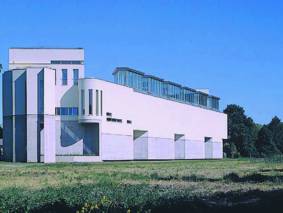
The
white-plastered volume rises above a high plinth of rough concrete on the ground
plan of a right-angled triangle broken open into a trapezium that follows the
form of the site – situated between the railway line and a tributary of the
Danube – and points to the baroque convent Klosterneuburg to the northwest, with
the tip of the triangle capriciously dissolved in a fan of concrete slabs,
Visitors enter the building at the opposite end, the narrow access wing to the
southwest, and are led directly from the foyer to the next level where a real
architectural landscape unfolds. On the right, the long exhibition wing –
organized by walls positioned crosswise and an inserted rotunda – opens onto a
garden in an inner courtyard. The wing’s wall of windows also lights at least
partially the enormous storage area underneath it, into which we can see by
means of a shaft that the architect calls a “room cut-out.” A narrow ramp leads
along the outside of this wall of windows to the great hall for temporary
exhibitions above it (which is also accessible from inside). Its curving roof,
shot through with narrow bands of light, presents an exciting contrast to the
glass lanterns on the opposite side that mark the silhouette of the longest
building wing in a meaningful way. Through these lanterns falls conventional
light from above into seven variously – sized gallery rooms – all trapezoid
because of their orthogonal grid. In an eventful rhythm – which, however,
eventually submits to a straight sequence of rooms – the rooms are linked to
each other and open gradually toward the courtyard, from which lateral light
also comes in through high, narrow openings.