DEPARTMENT OF ARCHITECTURE, NTUST @ 2003
B9013015 PangYen-Sung
Modern
History of Architecture
Home work …2003.12.22
39.
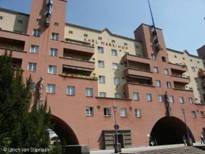
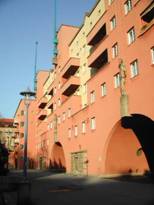
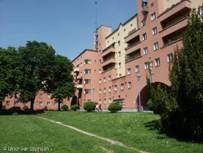
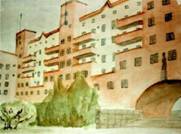
Karl-Marx-Hof, Wien, 1930 ---
Karl Ehn(1884-1957)
Open-air School,
Amsterdam, 1930 --- Johannes Duiker (1890-1935)
Pic-1 Pic-2 Pic-3
|
Architect |
Karl
Ehn(1884-1957) |
||||
|
Location |
|
||||
|
Date |
1930 |
||||
|
Building Type |
Multifamily
housing |
||||
|
Climate |
Temperate |
||||
|
Context |
Urban |
||||
|
Style |
|||||
|
Discussion |
"The
contrast with the aims and methods of American Redevelopment could hardly be more
striking. The most eloquent masterpiece among the groups was surely Darl
Ehn's Heiligenstadt Houses (the Karl Marx Hof) of 1927-1930—a mighty
fortress, where the major facade is a proud, dark banner of socialist
solidarity. It was to be stormed alike by the troops of Dollfuss and the Red
Army. It clearly infuriated many people, a little bit as the Guild House does
today, but its powerful shapes, Piranesian on the exterior but much more
gently articulated in the lovely garden courtyards, in fact historically
culminate and bring to an enormous social climax the special Viennese
tradition of Otto Wagner and his school. The scale is grander, like that of
all the Viennese housing, than that of the Guild House, but the two buildings
are related insofar as they both gesture like signboards to tell us what they
are about. How correct the gentle irony of the American example is in this
particular instance, and how stirring the Austrian's truimphant deployment:
in simple political fact daring hell and surviving." — Vincent Scully, Jr. Modern Architecture: The
Architecture of Democracy. p54. |
||||
|
Depresentation |
Karl
Marx Hof is a was originally built in response to the need for additional
housing for residents of |
||||
|
Plan |
Pic-4
Pic-5 |
||||
|
Reference |
VIENNA.COM http://www.vienna.com/1370_24789.htm Stipvisiten http://www.stipvisiten.de Archi-map http://www.archi-map.net/ Archinform http://www.archinform.net/projekte/5212.htm?ID=fb289022025a972e73157b37bb9ad39f
|
||||
|
Photo Provenience |
Pic-1 http://www.stipvisiten.de/images/wien3/pictures/pict3152.html Pic-2 http://www.stipvisiten.de/images/wien3/pictures/pict3151.html Pic-3 http://comp.uark.edu/%7Emjwhitl/KMHof4.JPG Pic-4 Pic-5 http://members.aon.at/sabine.budin/bilder_gross/karl_marx_hof-G.jpg |
||||
|
|
|
||||
|
|
|




DEPARTMENT OF ARCHITECTURE, NTUST @ 2003 B9013015 PangYen-Sung